

If your lawn treatment company sprayed for weeds and the creeping Charlie is still there, the treatment probably was not wrong. Creeping Charlie shrugs off the standard broadleaf herbicide that kills dandelions and clover, and it needs a different active ingredient applied in a narrow window in the fall.
This is one of the most common frustrations we hear from homeowners across Hamilton County, and it is usually the reason someone has already fired one or two lawn care companies before they call us. The weed is not evidence that nobody treated the lawn. It is evidence that the wrong product was used at the wrong time of year.
Is creeping Charlie the same thing as ground ivy?
Yes. Creeping Charlie, ground ivy, and creeping jenny are all common names people use for Glechoma hederacea, a low, spreading perennial in the mint family. You can identify it by its scalloped, round leaves, its square stems, and the faint minty smell when you crush it. In spring it throws small purple flowers.
The names matter only because they cause confusion on the phone. A homeowner calls asking about creeping jenny, the office writes down ground ivy, and everyone is talking about the same plant.
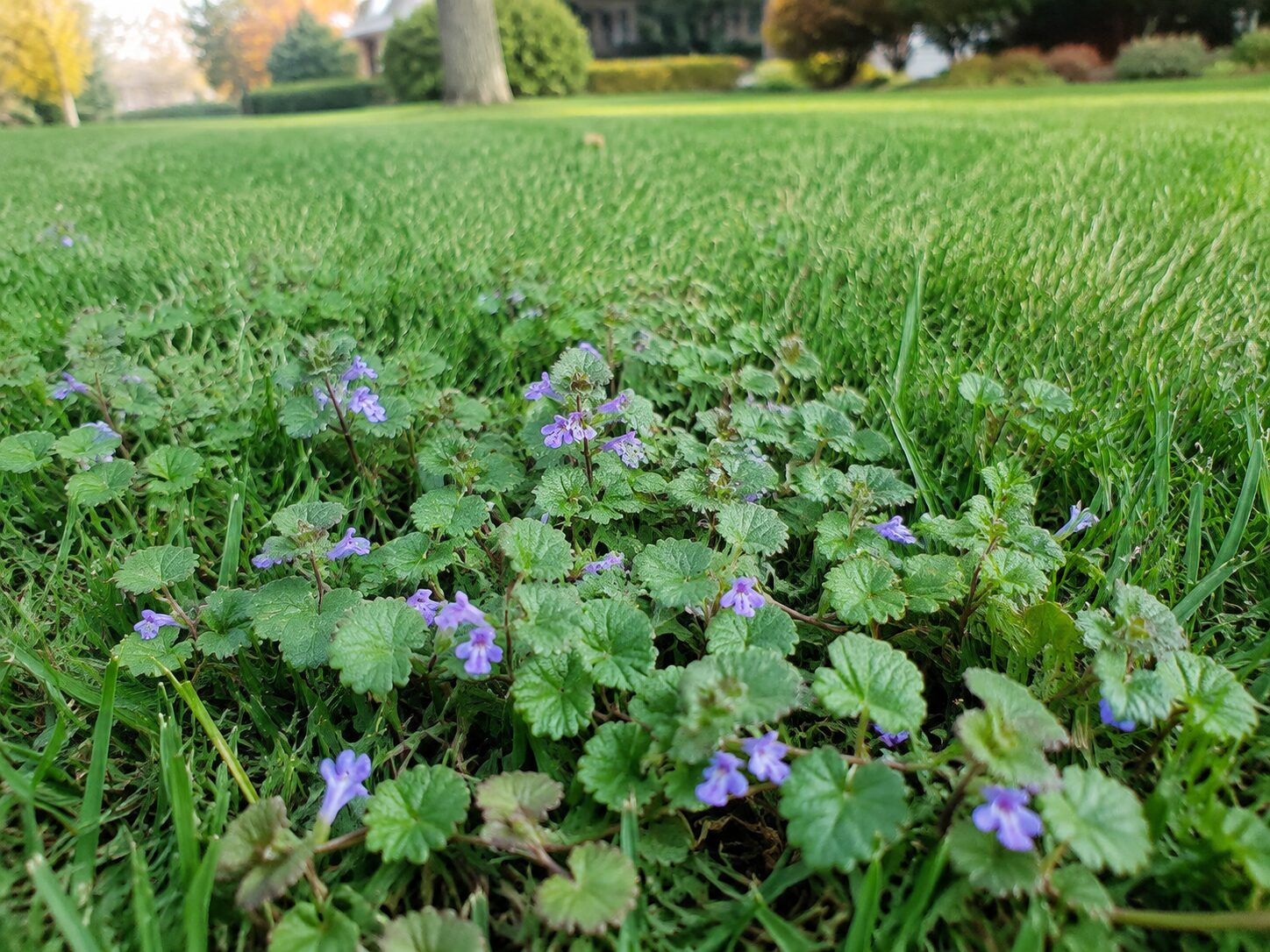
Why does regular weed control not kill it?
Two reasons, and both are physical rather than a question of effort.
First, the leaf surface. Creeping Charlie carries a waxy cuticle that sheds water-based herbicide before enough of it is absorbed. The product beads and rolls off. A dandelion has no such defense, which is why the same tank mix that wipes out dandelions can leave creeping Charlie visibly untouched.
Second, how it grows. Creeping Charlie spreads by stolons, above-ground runners that root at every node. Killing the foliage you can see does nothing to the network underneath. The plant regenerates from the nodes and closes the gap within weeks.
The way our owner explains it to homeowners: Tylenol and ibuprofen handle a headache or a sore elbow. If you snap your leg in half, they are going to give you something stronger. Standard broadleaf weed control is the ibuprofen. Creeping Charlie is the broken leg.
What actually works on creeping Charlie?
Chemistry first. Purdue University’s turfgrass science program ranks the effective active ingredients in order: triclopyr first, then fluroxypyr, then 2,4-D. Most standard three-way broadleaf products lean on 2,4-D, which is the weakest of the three against this particular weed. That single fact explains most failed creeping Charlie treatments.
Timing matters as much as the product. Purdue’s guidance is that applications from mid-September to mid-October give the best long-term control. Spring applications will produce visible damage, and the plant will look like it is dying, but the results do not hold. In fall the plant is actively moving sugars down into its root system ahead of winter, and it carries the herbicide down with them. Spring growth moves the other direction.
Expect more than one application. Because every rooted node is effectively an independent plant, a single pass rarely finishes the job. Purdue notes plainly that multiple applications may be necessary.
What about wild violet?
Wild violet (Viola species) behaves the same way and is arguably harder. It has the same waxy leaf, and it spreads by underground rhizomes rather than surface runners, so there is even less of the plant exposed to anything you spray. It also tolerates shade well, which is why it colonizes the north side of a house and under trees.
The good news is that the treatment plan is nearly identical: triclopyr-based product, fall application, more than one pass, patience across a full season. If a company is treating your violets in May and telling you it will be gone by June, that is a promise the plant will not keep.
Does anything besides herbicide help?
Yes, and it is the part most homeowners skip. Creeping Charlie is opportunistic. It moves into turf that is thin, shaded, damp, or mown too short, because those are conditions where grass cannot compete.
Purdue’s cultural recommendations are specific:
- Mow at three inches or higher. Taller turf shades the soil surface and denies low-growing weeds the light they need.
- Reduce shade where you can. Thinning or limbing up trees changes the conditions that favor the weed over the grass.
- Feed the lawn, weighted toward fall. Purdue supports up to 4.0 lbs of nitrogen per 1,000 square feet per year, with the primary feeding in autumn.
The most durable defense against creeping Charlie is turf thick enough that there is nowhere for it to establish. Herbicide clears what is there. Density is what keeps it from coming back.
How do you tell a real plan from a company chasing its tail?
We regularly take over lawns where a homeowner has been through five or six companies. The pattern is almost always the same: the lawn has several problems at once, wild violet and creeping Charlie and nimblewill and bentgrass, and each company treats whichever one is most visible that month. Something knocks back, something else takes its place, and the homeowner keeps paying for specialty treatments without the lawn ever getting ahead.
A company that has thought it through will tell you three things before taking your money:
- Which weeds are in the lawn, by name. Creeping Charlie, violet, and nutsedge each need a different approach. A quote that just says “weed control” has not looked closely.
- When the treatment will actually happen. If the answer for creeping Charlie is not autumn, ask why.
- How long it will take. Honest answer for an established infestation is more than one season.
Sometimes the right recommendation is not a specialty treatment at all. When a lawn is far enough gone, starting over, clearing it and reseeding, costs less than years of chasing individual weeds. That is a harder conversation and a better outcome, and we would rather have it early than sell someone four seasons of treatments that were never going to win.
Where this fits in a normal treatment program
Creeping Charlie and wild violet are not covered by a standard broadleaf application, and we say so up front rather than after three rounds have not worked. Our lawn fertilization and weed control program runs seven visits a year roughly 30 to 45 days apart, which puts a technician on the property inside the fall treatment window when these weeds are actually vulnerable. Nutsedge we spot treat as part of regular service. A consistently wet area where it has taken hold needs its own treatment.
We work throughout Carmel and the surrounding Hamilton County communities, where heavy glacial clay and mature tree cover create exactly the damp, shaded conditions creeping Charlie prefers.
Frequently asked questions
Is creeping Charlie the same as ground ivy?
Yes. Creeping Charlie, ground ivy, and creeping jenny are all common names for Glechoma hederacea. You can identify it by scalloped round leaves, square stems, and a minty smell when crushed.
Will my regular lawn treatment kill creeping Charlie?
Usually not. Most standard broadleaf programs are built on 2,4-D, which Purdue ranks as the least effective of the three common options against this weed. Products based on triclopyr or fluroxypyr work considerably better.
When is the best time to treat creeping Charlie in Indiana?
Mid-September to mid-October. Purdue’s turf program reports that fall applications give far better long-term control than spring applications, because the plant is moving resources down into its roots and carries the herbicide with them.
Why does creeping Charlie keep coming back?
It spreads by stolons that root at every node, so each rooted point can regenerate the patch. Killing visible foliage does not affect the network underneath, which is why multiple applications are usually required.
Are wild violets harder to kill than creeping Charlie?
Generally yes. Wild violet spreads by underground rhizomes rather than surface runners, so less of the plant is exposed to a foliar spray. It responds to the same triclopyr-based products on the same fall timing, but it typically takes longer.
Can I get rid of creeping Charlie without herbicide?
On a small patch, persistent hand pulling can work if you remove every rooted node, though it is slow and it recolonizes from any fragment left behind. Across a whole lawn, the realistic approach is correcting the conditions that favor it, mowing height, shade, and turf density, combined with properly timed treatment.
A note on products: herbicide names here are given as active ingredients, not brand recommendations. Indiana requires a license to apply pesticides commercially, and any product, professional or consumer, must be used according to its label. The label is the law. For current Indiana-specific turf guidance, Purdue Extension’s turfgrass program is the authority we rely on.